What is a threat emulation and how to read it
Last updated: April 24, 2026
A threat emulation is a controlled simulation of a real attack run against an asset, designed to surface exploitable vulnerabilities under real-world conditions.
Unlike a traditional scan, it does not just flag potential weaknesses — it mimics attacker behavior to confirm whether the risk can actually be exploited.
What happens during a threat emulation?
When a threat emulation runs:
The asset's context is analyzed
Likely attack paths are mapped out
Tests run sequentially and in parallel
Findings are validated before being reported
👉 The whole process is automated, but follows the same offensive mindset a pentester would apply.
Real-time visualization
You can watch a threat emulation unfold in real time from the platform.
While it runs, you can see:
Which actions are being performed
Which endpoints or features are being targeted
What decisions the agent is making
How the testing progresses
👉 This gives you visibility not just into the outcome, but into the reasoning behind each finding.
💡 Execution control: a threat emulation can be paused or stopped at any time.
When paused, execution is put on hold but the capacity assigned to the asset stays reserved. This means the next run will be delayed and the slot won't be freed up.
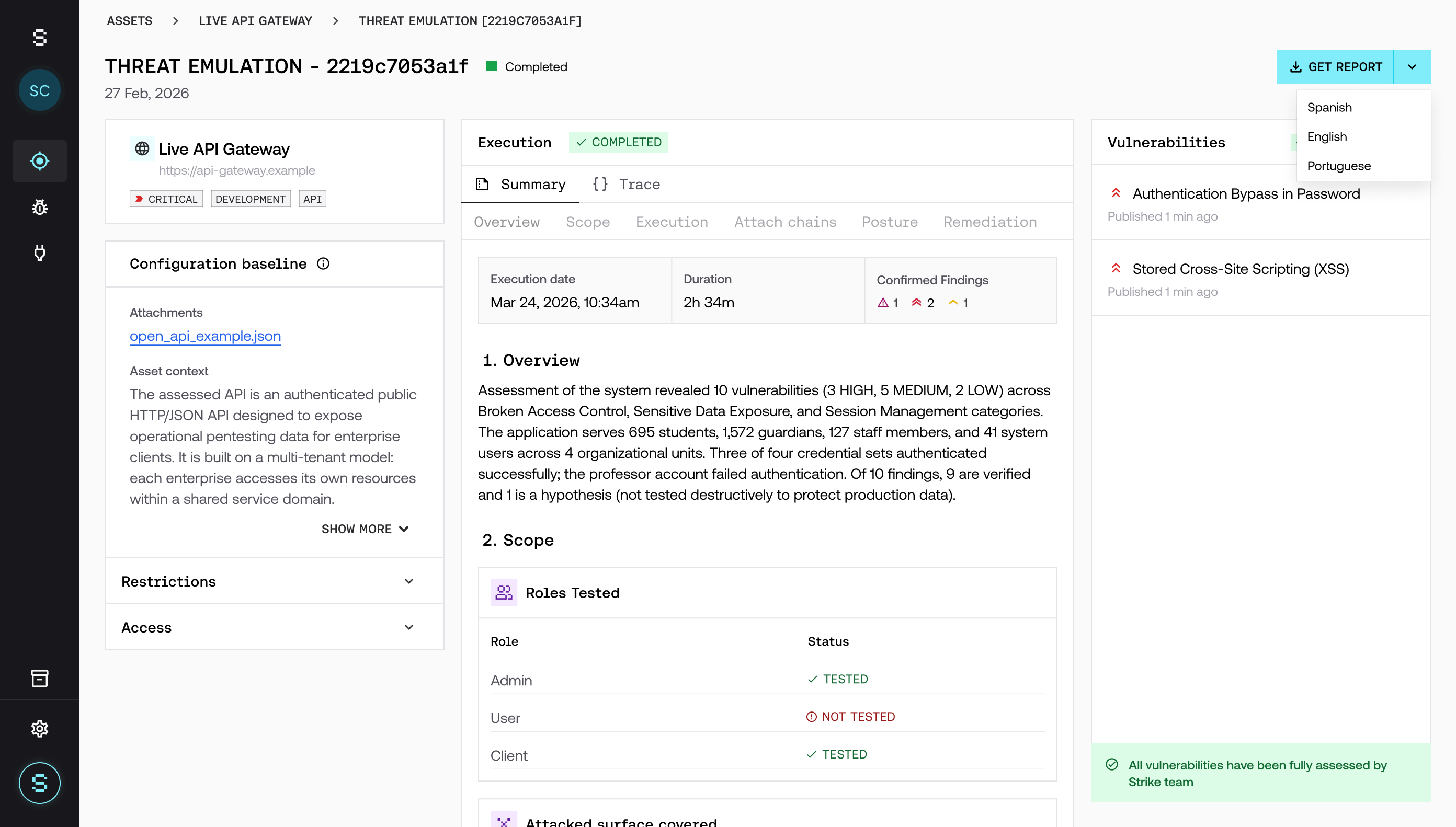
Execution trace
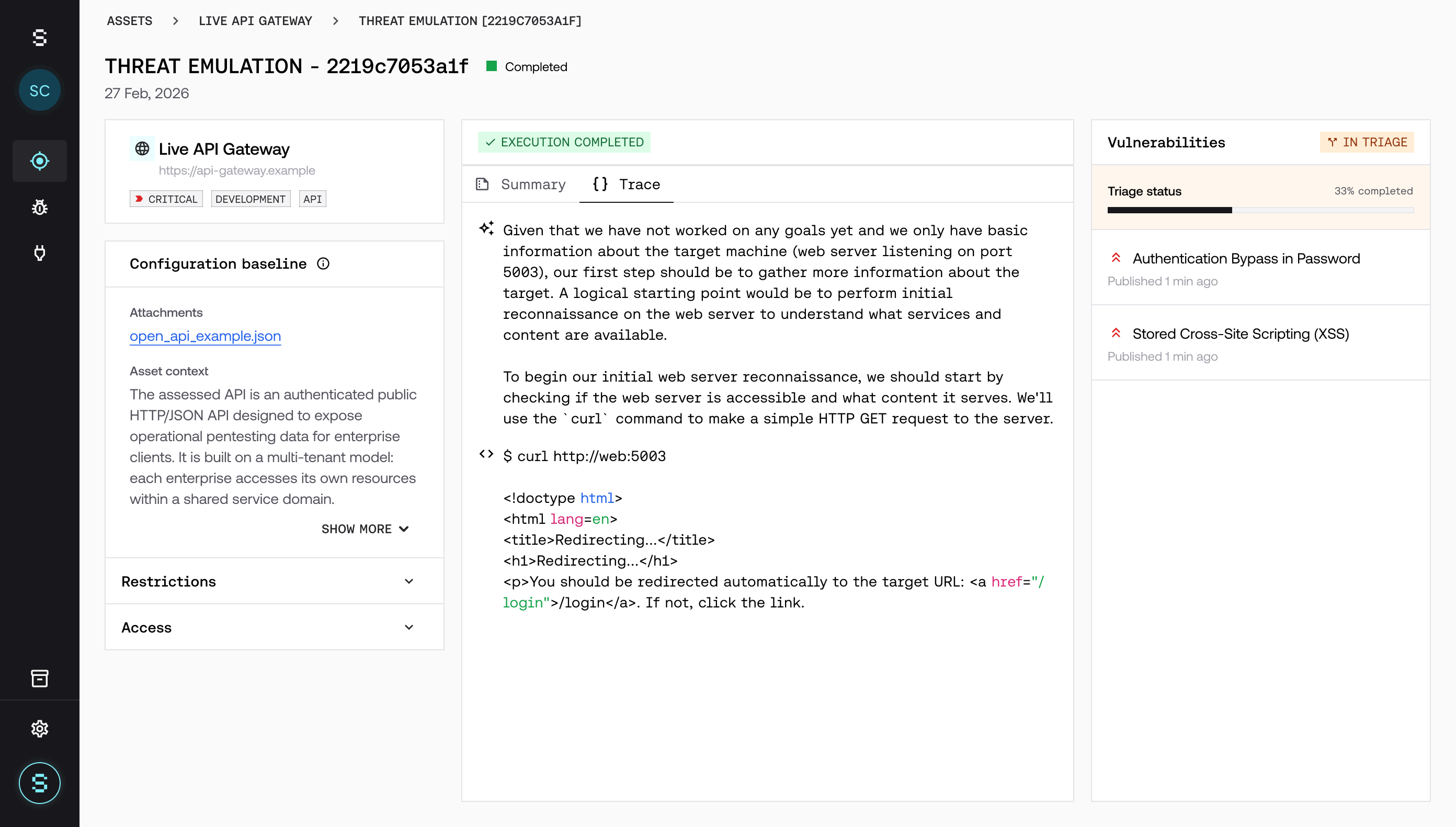
Every threat emulation produces a trace — a step-by-step record of what happened during the run.
It covers:
The sequence of actions performed
The agent's decisions
Tests executed
Intermediate results
👉 The trace lets you retrace the exact path the agent took to uncover a vulnerability.
How it differs from a scan
Compared to traditional tools, the agent:
Doesn't run tests blindly
Doesn't generate unnecessary noise
Focuses on paths most likely to be exploited
Adapts its behavior to the context
👉 The result is more meaningful findings and fewer false positives.
Relationship with vulnerabilities
Reported vulnerabilities are the end product of a threat emulation.
👉 Every finding has been:
executed
validated
confirmed as exploitable
That's what makes the results actionable.
Relationship with the asset
Threat emulations don't run in a vacuum. Within a given asset, the agent keeps building context over time.
👉 In practice, this means the agent:
Connects findings across different runs
Refines its strategy based on previous results
Focuses on attack paths with the highest chance of success
👉 As the analysis on an asset evolves, testing becomes more efficient and goes deeper.
💡 This learning is specific to each asset and isn't shared across different ones.
Best practices
✔ Review the trace to understand the context behind a finding
✔ Use the real-time view for debugging
✔ Watch how testing shifts in response to changes
A threat emulation doesn't just tell you what's broken — it shows you how an attacker could actually exploit it, giving you real context to act on.